
general
The Full Picture: How Search Actually Works, End to End

Article written by
Vismaya
10 min
2026-04-07
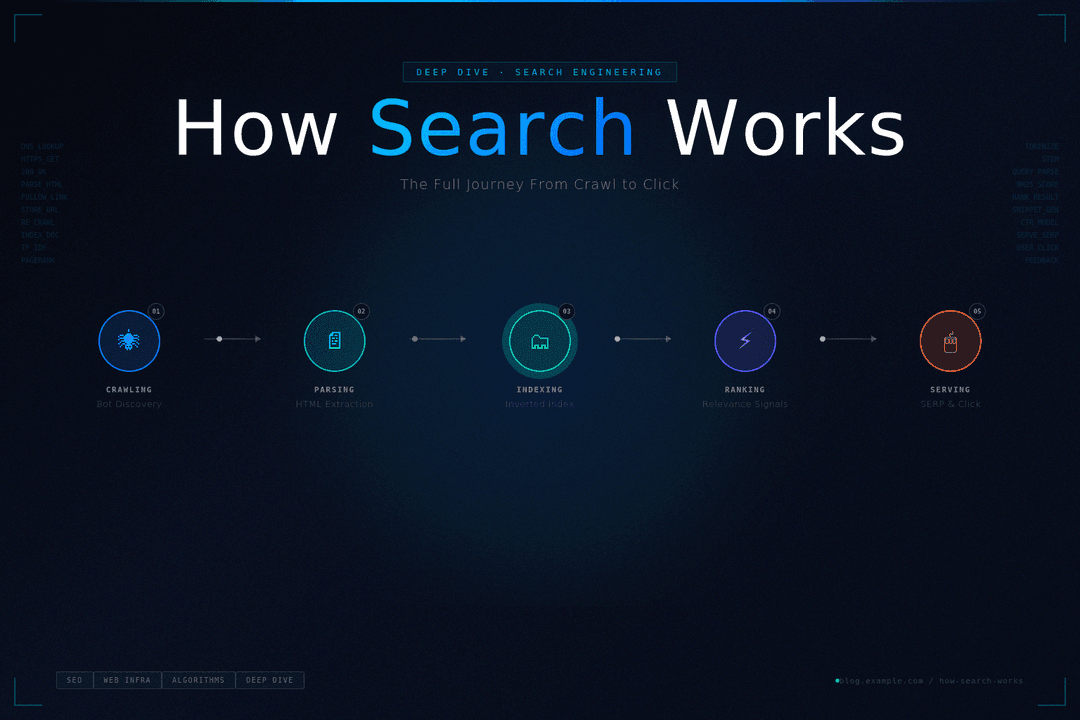
If you've been reading through this series — how search engines think, how crawling works, indexing, ranking, search intent, and SERP anatomy — you now have six separate pieces of knowledge. Each one is useful on its own.
But the real power comes from connecting them into a single mental model. Because in practice, SEO problems don't arrive labelled "this is an indexing problem" or "this is an intent problem." They arrive as: "our traffic dropped" or "we're not ranking" or "nobody's clicking." Your job is to trace backward through the entire chain and find where it breaks.
This article connects everything into one flow. After reading it, you should be able to look at any website, any page, any keyword — and reason your way from problem to diagnosis to fix.
The Chain: Crawl → Index → Rank → Match → Click
Every time someone searches Google and lands on a webpage, five things happened in sequence. If any one of them failed, the visit wouldn't have occurred.
1. Google found the page (Crawl) Googlebot discovered the URL through an internal link, external link, or sitemap. It visited the page, downloaded the HTML, rendered the JavaScript, and followed all the links on the page. The page had to be accessible — not blocked by robots.txt, not behind a login, not returning a server error.
2. Google decided the page was worth remembering (Index) After crawling, Google processed the content — extracting text, identifying entities, understanding relationships, evaluating quality. It then made a decision: is this page worth storing in the index? If the content was thin, duplicate, or low-quality, it got discarded. If a noindex tag was present, it was deliberately excluded. Only pages that pass this quality gate get stored.
3. Google ranked the page for relevant queries (Rank) Being indexed doesn't mean being visible. Millions of pages are indexed for any given topic. Google's ranking algorithm evaluates each indexed page against three pillars — relevance, authority, and experience — to determine the order. Position 1 vs position 50 is the difference between being seen and being invisible.
4. The page matched the searcher's intent (Match) Ranking high isn't enough if the intent is wrong. A page ranking #3 for a keyword where users want a comparison but finding a definition will get skipped. The page has to not only rank — it has to answer the actual question behind the search. Google measures this through user behaviour. Pages that satisfy intent keep their position. Pages that don't gradually lose it.
5. The searcher chose to click (Click) The user sees the results page — title, URL, description, SERP features. They make a split-second decision about which result to click. Your title, meta description, and any rich results (FAQ dropdowns, star ratings, dates) determine whether you get the click or the competitor below you does.
Five stages. Break at any stage and the chain fails.
.png)
How to Diagnose Any SEO Problem Using This Chain
When something isn't working — traffic is down, a page isn't ranking, nobody's converting — don't start randomly tweaking things. Trace the chain.
"My page isn't showing up in Google at all"
Start at Stage 1.
Is it crawled? Check Google Search Console → URL Inspection. Paste the URL. If it says "URL is not on Google," the page isn't indexed. Check if it's been crawled at all.
If not crawled: Is the page linked from anywhere? Is it in the sitemap? Is robots.txt blocking it? Can Googlebot access it?
Is it indexed? If it was crawled but not indexed, Google saw the page and decided not to keep it. Check the Pages report in Search Console for the specific exclusion reason. "Crawled — currently not indexed" means the content wasn't good enough. "Duplicate" means Google thinks another page already covers this. "Noindex" means there's a tag telling Google to skip it.
Fix the Stage 1 or Stage 2 issue before worrying about anything else. No amount of keyword optimisation helps a page Google hasn't stored.
"My page is indexed but doesn't rank on page 1"
You've passed Stages 1 and 2. The problem is Stage 3 — ranking.
Which pillar is weakest?
Relevance: Search your target keyword. Look at the top 5 results. Does your content match the same intent? Is it the same format (guide vs listicle vs product page)? Does it cover the same subtopics with equal or better depth? If the top results are 2,500-word comparison guides and you have an 800-word overview, there's your gap.
Authority: Does your site have topical authority on this subject? Do you have other pages in the same cluster linking to this one? Have other websites linked to this specific page or to your site's content on this topic? If the top results are from sites with hundreds of articles and thousands of backlinks in this space, you need to narrow your keyword target or build more supporting content.
Experience: Does your content show real first-hand knowledge? Are there specific details, original examples, practitioner insights? Or does it read like it was assembled from other sources? Compare the experience signals in your content to the top-ranking pages.
"My page ranks but nobody clicks"
Stages 1-3 are working. The problem is Stage 5 — the click.
Check Search Console → Performance. Find the page. Look at impressions vs clicks. If impressions are high but CTR is below 2%, your SERP listing isn't compelling enough.
Title tag: Is it specific and relevant to the query? Or is it vague and generic? Does it stand out from the titles above and below it? The title is the single biggest CTR factor.
Meta description: Does it tell the searcher what they'll get if they click? Does it address their specific need? Or is it a generic company description?
SERP competition: What SERP features appear above your result? If there's an AI Overview, a featured snippet, and 4 ads before your organic result, even position #1 will have low CTR. For these keywords, you need to target the SERP features themselves — win the featured snippet, get cited in the AI Overview through AEO.
"My page gets clicks but no leads or conversions"
The entire search chain works. Stages 1-5 all passed. The problem is Stage 4 — intent match — but at a deeper level.
You're attracting visitors. But they're not the right visitors, or the page isn't guiding them toward action.
Wrong audience: The keyword brings traffic but the intent doesn't align with your ICP. This is exactly the blog traffic but no enquiries problem — high-volume keywords attracting researchers, students, or competitors instead of buyers.
No conversion path: The visitor got value from your content but had nowhere to go next. No internal link to a relevant service page. No CTA that matches their current mindset. No landing page built for the intent your content created.
Intent mismatch between content and offer: An informational article with a hard "buy now" CTA will convert poorly. The reader came to learn, not to buy. Match the CTA to the intent: informational content → offer more depth (newsletter, guide download). Commercial content → offer comparison help (consultation, audit). Transactional content → offer the thing they're looking for (pricing, demo, contact).
The Mental Model in Practice: A Real Example
Let's walk through a concrete example. A local bakery in Kochi has a website. They've published 30 blog posts about baking tips. Traffic is growing. But nobody walks into the shop because of the blog.
Tracing the chain:
Stage 1 (Crawl) — The posts are being crawled. Search Console shows regular crawl activity.
Stage 2 (Index) — All 30 posts are indexed. No issues.
Stage 3 (Rank) — Several posts rank on page 1 for their target keywords like "how to make eggless cake at home" and "best buttercream frosting recipe."
Stage 4 (Intent Match) — ⚠️ The intent behind these keywords is "I want to bake this myself at home." The people finding these posts are home bakers — not people looking for a bakery to order from. The content matches the search intent perfectly, but that intent has nothing to do with the business goal.
Stage 5 (Click) — People do click. CTR is healthy.
The diagnosis: The problem isn't technical. It's strategic. The blog targets keywords whose intent doesn't align with the business model. A bakery needs people who want to buy cakes, not people who want to bake them.
The fix: Add content targeting commercial and transactional intent — "custom birthday cakes Kochi," "best bakery for wedding cakes Kerala," "order cakes online Kochi." These have lower volume but the intent directly connects to revenue. Keep the informational posts for brand building, but add a conversion path: "Want this made for you instead? Order from our shop."
One diagnosis. Five stages checked. Problem found at Stage 4. Fix is strategic, not technical.
The Connection to AI Search
Everything in this chain also applies to AI search — but compressed.
When someone asks ChatGPT or Perplexity a question, the AI tool runs a similar chain: retrieve content (crawl equivalent), evaluate quality and relevance (index + rank equivalent), match to the user's intent, and present the answer.
The difference is that Stages 4 and 5 collapse. The AI doesn't show the user a list to choose from. It presents the answer directly, citing sources. There's no "click" decision for the user — the AI makes the selection.
This means your content has to be so clearly the best answer that the AI picks it without any user input. Answer-first structure, extractable passages, entity density, FAQ schema — these are the AEO signals that make your content the AI's first choice.
The mental model stays the same. The competition just got more intense at the match stage.
The Questions You Should Now Be Able to Answer
If the chain is clear, you should be able to reason through these scenarios without looking anything up:
Scenario 1: A client's new website has been live for 3 months. They've published 20 pages. Search Console shows only 8 are indexed. Where do you start?
You start at Stage 2. Why are 12 pages not indexed? Check the Pages report. Are they "Crawled — currently not indexed" (quality issue)? Or "Discovered — currently not indexed" (priority/linking issue)? Or "Duplicate" (canonical issue)? The answer determines the fix.
Scenario 2: A page ranks #4 for its target keyword. The client wants it at #1. What do you analyse?
You compare your page to the current #1 across all three ranking pillars. Is their content more relevant to the intent? Do they have more authority (backlinks, topical depth)? Do they have stronger experience signals? The weakest pillar is where you invest effort.
Scenario 3: A blog post ranks #1 and gets 5,000 visits per month. Zero conversions. What's wrong?
Intent mismatch. The keyword attracts people whose intent doesn't align with the business goal. Or the conversion architecture is missing — no CTA, no next step, no landing page. Check which one by looking at who's actually visiting (Search Console query data) and what happens after they land (analytics behaviour flow).
Scenario 4: A page was ranking #2 last month. This month it's at #15. Nothing changed on the page. What happened?
Either: Google changed how it evaluates intent for this keyword (check if the SERP results have fundamentally changed). Or: a competitor published better content that now outperforms yours on relevance, authority, or experience. Or: a Google algorithm update reweighted one of the ranking pillars. Check Google's official blog for recent updates, then compare your page to the new #1-3 results.
The Foundation Everything Else Builds On
Every advanced SEO technique — keyword research, content strategy, technical optimisation, link building, AEO — is a more specific application of this chain. Keyword research is about finding queries where you can win at Stages 3 and 4. Content strategy is about systematically covering intent across Stage 4. Technical SEO is about fixing Stages 1 and 2. Link building strengthens Stage 3. AEO extends the chain to AI search.
If the chain is solid in your head, nothing in SEO will ever feel random or confusing again. When something breaks, you'll know where to look. When someone proposes a tactic, you'll know which stage it affects and whether it's worth the effort.
This is the foundation. Everything from here — technical SEO deep dives, content strategy frameworks, AEO implementation, analytics — builds on top of this chain. If you can trace from crawl to click for any page on any site, you're already thinking like a practitioner, not a course graduate.
Key Takeaways
Search works in five connected stages: Crawl → Index → Rank → Match Intent → Get Click. Break at any stage and the entire chain fails.
Diagnosing SEO problems means tracing this chain backward from the symptom. "Not ranking" could be a crawl problem, an index problem, or a ranking problem — each has a completely different fix.
The three ranking pillars (relevance, authority, experience) only matter after a page is crawled and indexed. Technical foundations come first, always.
Intent mismatch is the most common cause of "good traffic, bad results." A page can rank #1 for a high-volume keyword and generate zero business value if the wrong audience is searching.
AI search compresses Stages 4 and 5 — the AI picks the answer for the user instead of presenting options. This makes intent matching and content structure even more critical.
Every advanced SEO technique maps to a specific stage in this chain. Understanding the chain means you can evaluate any tactic, tool, or strategy by asking: which stage does this improve, and is that the stage where my problem actually lives?
Ready to learn digital marketing the way it's actually done? Talk to the Academy Lead →
No 47 certifications. Just the skills that make you valuable.
Opening Hours
Mon - Fri 9AM - 8PM
Sat - Sun 10AM - 5PM
“Beware of little expenses, a small leak will sink a great ship”
— Benjamin Franklin

“Beware of little expenses, a small leak will sink a great ship”
— Benjamin Franklin
Copyright © WizGrowth Inc. 2025