
general
Which Digital Marketing Specialisation Should You Choose? An Honest Breakdown for 2026.

Article written by
Vismaya
14 min
2026-04-17
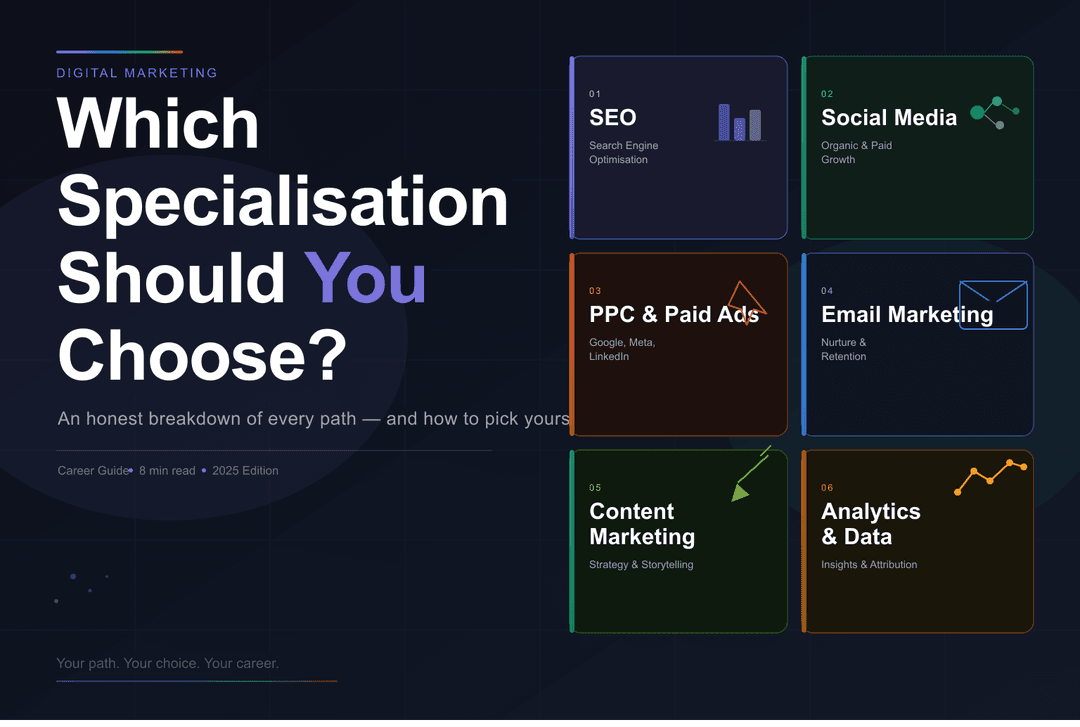
You've decided digital marketing is the career. Good. Now comes the question that freezes most people for months: which part of it?
SEO? Performance marketing? Content strategy? Social media? Email? Analytics? Every article you read says all of them are "in demand" and all of them have "great career scope." Which is technically true and practically useless — because you need to pick a starting direction, and nobody is helping you figure out which direction matches you.
The advice I'm going to give you isn't based on market reports. It's based on years of working alongside specialists in every one of these areas, hiring them, managing them, and watching who thrives and who burns out in each role. The right specialisation isn't the one with the highest average salary on a job portal. It's the one that matches how your brain works.
The Truth About Specialisation Nobody Tells You
Before I break down each path, here's something important: you don't need to pick on day one.
Every good digital marketer starts as a generalist. You learn the full landscape — SEO, ads, content, social, email, analytics — and you develop a working understanding of how they all connect. Then, over your first 12-18 months of actual work, one or two areas pull you in. You find yourself spending extra time on SEO articles because you're fascinated by how Google makes ranking decisions. Or you realise you get a rush from watching a Google Ads campaign hit profitability in real time. Or you discover that you love building content systems more than running campaigns.
That natural pull is the signal. Follow it.
The danger is choosing too early based on what sounds impressive or what pays the most on paper — and ending up in a specialisation that doesn't match your temperament. A high-paying role you hate is a miserable career. A slightly lower-paying role you're genuinely good at leads to a much higher ceiling because passion drives depth, and depth drives value.
At WizGrowth Academy, we teach the full stack first — strategy, SEO, paid ads, content, social, email, analytics — precisely so students can discover their natural pull during the programme instead of guessing before it.
That said, here's what each path actually looks like. Not the job description version. The real version.
SEO — For the Patient, Curious, Systems Thinker
What the work actually looks like
You spend your days understanding how search engines crawl, index, and rank content. You research what people are searching for, figure out what intent sits behind those searches, and build or optimise content that satisfies that intent better than anything else currently ranking.
Some days you're deep in Google Search Console analysing why pages are indexed or excluded. Other days you're writing content briefs, building internal linking architectures, fixing technical issues, or earning backlinks through outreach. In 2026, you're also structuring content for AI answer engines — AEO is now a core SEO skill, not a separate discipline.
Who thrives here
People who enjoy understanding systems. SEO is a puzzle — Google's algorithm has hundreds of signals, and your job is to figure out which ones matter for this specific site, this specific keyword, this specific competitive landscape. If you enjoy pulling threads, testing hypotheses, and watching a long-term strategy compound over months, SEO is deeply satisfying.
You need patience. Real patience. You'll publish a piece of content, optimise it correctly, and then wait 3-6 months to see it rank. The people who love SEO are the ones who find that wait exciting, not frustrating. They understand that the work they do today pays off next quarter — and keeps paying off for years.
Who burns out
People who need instant feedback. If you need to see the result of your work today — not in four months — SEO will drain you. Also, people who hate writing or reading long-form content. SEO in 2026 is inseparable from content. If you don't enjoy building content systems, you'll be miserable as an SEO specialist.
Salary reality in India (2026)
Entry level: ₹15,000-₹25,000/month. Mid-level (2-4 years): ₹40,000-₹70,000/month. Senior/lead (5+ years): ₹80,000-₹1,50,000/month. Independent consultants with proven results: ₹1,50,000-₹3,00,000+/month.
SEO specialists who also understand AEO and technical SEO command a significant premium over those who only do on-page optimisation and keyword research. The more technical your SEO skill set, the higher your ceiling.
Career trajectory
Junior SEO Executive → SEO Specialist → Senior SEO Strategist → Head of Organic Growth / SEO Director → Independent Consultant or Agency Owner. Alternatively: SEO → Content Strategy → Head of Marketing (many marketing leaders have SEO backgrounds because SEO teaches you how customers think).
Performance Marketing (Paid Ads) — For the Data-Driven, Speed-Loving Optimiser
What the work actually looks like
You manage ad campaigns across Google Ads, Meta Ads (Facebook/Instagram), LinkedIn Ads, and sometimes YouTube or TikTok. Your day revolves around numbers: cost per click, cost per lead, conversion rate, return on ad spend (ROAS), cost per acquisition (CPA).
You build campaigns, write ad copy, design targeting audiences, set budgets, launch, monitor, and optimise. Every day you're looking at data and making decisions: this ad set is working — scale it. This keyword is burning money — cut it. This audience converts at 3% while this one converts at 0.5% — shift the budget.
Performance marketing is the closest thing to a real-time feedback loop in digital marketing. You can launch a campaign at 9 AM and see results by noon.
Who thrives here
People who love numbers and speed. If you enjoy spreadsheets, dashboards, and making quick decisions based on data, performance marketing is addictive. There's a dopamine hit when a campaign crosses profitability — when you can look at the data and say "I spent ₹50,000 and generated ₹3,00,000 in pipeline." That clarity attracts people who like proving their impact with hard numbers.
You also need to be comfortable with money. You're spending someone else's money every day — sometimes ₹10,000/day, sometimes ₹1,00,000/day. A wrong decision is a wrong decision that costs real money. The people who thrive here are the ones who can make budget decisions calmly, not the ones who panic every time a campaign underperforms for a day.
Who burns out
People who hate volatility. Ad platforms change constantly. An ad that worked yesterday might stop working tomorrow because the algorithm shifted, a competitor entered the auction, or the audience got fatigued. If constant adjustment stresses you out, this role will exhaust you.
Also, people who want creative freedom. Performance marketing is creative — ad copy and visual design matter enormously — but the creativity is constrained by data. You don't get to make something beautiful for the sake of beauty. You make something that converts. If the ugly ad gets more clicks than the pretty one, you run the ugly ad. That tension kills creative-first people.
Salary reality in India (2026)
Entry level: ₹18,000-₹30,000/month. Mid-level (2-4 years): ₹50,000-₹90,000/month. Senior/lead (5+ years): ₹1,00,000-₹2,00,000/month. Independent performance marketers managing large budgets: ₹2,00,000-₹5,00,000+/month.
Performance marketing has the highest salary ceiling among all digital marketing specialisations because the impact is directly measurable. If you can prove you generated ₹1 crore in revenue from ₹10 lakh in ad spend, you can charge accordingly.
Career trajectory
PPC Executive → Performance Marketing Specialist → Senior Performance Marketer → Head of Growth / Performance Director → Growth Consultant or Agency Owner. Alternatively: Performance Marketing → Product Marketing → Growth Lead (especially in SaaS and startups).
Content Marketing — For the Strategic Writer and Storyteller
What the work actually looks like
You plan, create, and distribute content that attracts, educates, and converts an audience. Blog posts, case studies, landing pages, email sequences, whitepapers, video scripts, social content — all of it falls under content marketing.
But here's what most people miss: content marketing is not just writing. The writing is maybe 40% of the job. The other 60% is strategy — figuring out what content to create, who it's for, where it sits in the buyer journey, what keyword it targets, what action it should drive, and how it connects to every other piece of content on the site.
A content marketer looks at a business and builds a content system that generates traffic, builds trust, and creates leads — not just a pile of blog posts. The difference between a writer and a content strategist is the difference between someone who produces words and someone who builds a machine that produces business results.
Who thrives here
People who love both writing and thinking about why writing works. If you enjoy crafting a sentence until it's clean, researching a topic until you genuinely understand it, and then structuring a piece so the reader goes from "interesting" to "I need to contact this business" — content marketing will feel like home.
You need empathy. Great content marketers are obsessed with the reader — what they're feeling, what they're afraid of, what they need to hear. You're not writing for search engines (though matching search intent is essential). You're writing for a human being who has a problem and is deciding whether you understand it well enough to help.
You also need strategic patience. Like SEO, content marketing compounds over time. A piece you publish today might generate leads for three years. The best content marketers think in systems — content clusters, topic authority, funnel stages — not in individual posts.
Who burns out
People who only want to write. If the strategic layer — keyword research, funnel mapping, performance measurement, CMS management — bores you, you're a writer, not a content marketer. Both are valid careers, but they're different careers with different ceilings.
Also, people who need public credit. Content marketing is often invisible. The blog post that generated 200 leads doesn't have your face on it. The email sequence that converted 15% doesn't get applauded at the company all-hands. You're building the infrastructure that makes the business grow — but the business owner thanks the sales team, not you. If recognition matters more than impact, this role will frustrate you.
Salary reality in India (2026)
Entry level: ₹12,000-₹22,000/month (often the lowest starting salary in digital marketing because entry-level content roles are saturated with writers). Mid-level (2-4 years): ₹35,000-₹60,000/month. Senior content strategist (5+ years): ₹70,000-₹1,50,000/month. Independent content consultants for SaaS/B2B: ₹1,50,000-₹4,00,000+/month.
The ceiling for content marketing is high — but only for people who can think strategically, not just write well. A "content writer" earns ₹20,000. A "content strategist who builds systems that generate pipeline" earns ₹1,50,000+. Same field. Completely different skill set. Completely different pay.
Career trajectory
Content Writer → Content Marketing Specialist → Senior Content Strategist → Head of Content → VP of Marketing. Alternatively: Content Marketing → Brand Strategy → CMO track (content strategists who understand brand and conversion often rise to marketing leadership).
Social Media Marketing — For the Creative, Community-Driven Communicator
What the work actually looks like
You manage a brand's presence across Instagram, Facebook, LinkedIn, YouTube, Twitter/X, and whatever platform is trending next. You plan content calendars, write captions, brief designers, schedule posts, respond to comments and DMs, run organic campaigns, analyse engagement metrics, and try to build a community around the brand.
In 2026, social media marketing also means: understanding short-form video (Reels, Shorts), planning for platform-specific algorithms that change monthly, managing influencer relationships, running social commerce (selling directly through social platforms), and staying sane while everyone from the CEO to the intern has an opinion on what you should post.
Who thrives here
People who genuinely enjoy being online. Not as a consumer — as a strategist. You see a trending Reel format and immediately think "how can my brand use this?" You scroll LinkedIn and notice which post formats get engagement and why. You instinctively understand tone, timing, and platform culture.
You need creative energy — lots of it. Social media marketing requires producing a volume of content that would exhaust most people. And it needs to be good. Not just "posted on schedule" but engaging, on-brand, and connected to a business outcome.
You also need thick skin. Social media is public. People comment. People criticise. Brands get trolled. The social media manager is the first responder. If public scrutiny bothers you, this isn't your path.
Who burns out
Almost everyone, eventually. Social media marketing has the highest burnout rate in digital marketing. The always-on nature of the work — weekends, holidays, evenings, crisis management — takes a toll. The constant content production cycle is relentless. And the metrics can feel meaningless — 10,000 likes but the business owner asks "how many sales did this generate?" and you struggle to draw a direct line.
People who want deep, strategic work also burn out in pure social media roles. The day-to-day is tactical and fast-paced. If you want to sit with a problem for weeks and build a complex strategy, social media's pace won't let you.
Salary reality in India (2026)
Entry level: ₹10,000-₹18,000/month (the most oversupplied role in digital marketing). Mid-level (2-3 years): ₹25,000-₹45,000/month. Senior social media manager (4+ years): ₹50,000-₹80,000/month. Social media lead/head: ₹80,000-₹1,20,000/month.
Honest truth: social media marketing has the lowest salary ceiling among all specialisations unless you move into paid social (which crosses into performance marketing) or build a personal brand that makes you a thought leader in the space. Pure organic social media management is a career with a visible ceiling. Know this going in.
Career trajectory
Social Media Executive → Social Media Manager → Senior Social Media Strategist → Head of Social. Alternatively (and more lucrative): Social Media → Brand Marketing → Brand Strategy. Or: Social Media → Influencer Marketing → Creator Economy / Personal Brand.
Email Marketing & Automation — For the Systems Builder Who Loves Precision
What the work actually looks like
You build email campaigns, automated sequences, drip workflows, and lifecycle marketing systems. Welcome series for new subscribers. Nurture sequences for leads who aren't ready to buy. Re-engagement campaigns for dormant customers. Promotional campaigns for launches and offers.
In 2026, this role has expanded into marketing automation — connecting email with CRM systems, customer data platforms, chatbot flows, and behavioural triggers. You're not just sending emails. You're building automated systems that deliver the right message to the right person at the right time based on what they've done, clicked, opened, or ignored.
Who thrives here
People who love building systems that run without them. If the idea of designing a 12-email sequence that automatically nurtures a cold lead into a paying customer — while you sleep — excites you, this is your path.
You need precision. A wrong merge tag, a broken link, a misfired trigger — email mistakes are visible and embarrassing. The best email marketers are detail-obsessed. They test everything before it sends. They think in flows and decision trees. They're the kind of person who draws diagrams on whiteboards.
Who burns out
People who need creative variety. Email marketing can feel repetitive if you don't enjoy optimisation. You're testing subject lines, tweaking send times, adjusting CTAs — small changes, measured over time. If you need big, visible creative projects, the incremental nature of email will bore you.
Salary reality in India (2026)
Entry level: ₹15,000-₹25,000/month. Mid-level (2-4 years): ₹35,000-₹65,000/month. Senior email/automation specialist (5+ years): ₹70,000-₹1,30,000/month. Marketing automation consultants (Salesforce, HubSpot, Marketo): ₹1,50,000-₹3,00,000+/month.
Email and automation specialists who know specific platforms (HubSpot, Salesforce Marketing Cloud, Marketo, Klaviyo) command significant premiums because the platforms are complex and the talent pool is small. If you pair email marketing skills with CRM/platform expertise, you're in a very high-demand, high-pay niche.
Career trajectory
Email Marketing Executive → Marketing Automation Specialist → Senior CRM/Lifecycle Marketer → Head of Lifecycle/Retention Marketing. Alternatively: Email/Automation → Revenue Operations → VP of Marketing Ops (this path is growing fast in SaaS).
Analytics — For the Person Who Sees Stories in Numbers
What the work actually looks like
You're the person who makes sense of the data. You set up tracking — Google Analytics 4, conversion tracking, UTM parameters, attribution models — and then you interpret what the data is saying. Which campaigns are actually driving revenue? Which pages are leaking visitors? Where are people dropping off in the funnel? Is the ₹2 lakh ad spend generating a positive return?
You build dashboards, create reports, run analyses, and — most importantly — translate numbers into decisions. "The data says X, which means we should do Y" is the core sentence of your career.
Who thrives here
People who think in numbers first. When someone says "the campaign did well," you instinctively ask "what does 'well' mean? Show me the data." You're sceptical of claims without evidence. You enjoy finding patterns that other people miss.
You need communication skills alongside analytical ability. The most common failure mode for analytics specialists is being brilliant with data but unable to explain it to a business owner who doesn't think in percentages and conversion rates. The best analytics people are translators — they turn numbers into narratives that non-technical people can act on.
Who burns out
People who want to create, not measure. Analytics is observational — you're studying what already happened, not making new things happen. If you need the creative satisfaction of building a campaign or writing a piece of content, pure analytics will feel like watching from the sidelines.
Salary reality in India (2026)
Entry level: ₹18,000-₹30,000/month. Mid-level (2-4 years): ₹45,000-₹80,000/month. Senior analytics specialist (5+ years): ₹90,000-₹1,80,000/month. Analytics leads/directors: ₹1,50,000-₹3,00,000+/month.
Analytics is the most underrated high-paying specialisation. Fewer people pursue it (because it's not "exciting" like social media or performance marketing), which means less competition and faster career growth for those who do. Companies desperately need people who can prove what's working and what's not — and they'll pay well for that clarity.
The Combinations That Pay the Most in 2026
The highest-earning digital marketers aren't pure specialists. They're T-shaped — deep in one area and functional in one or two adjacent areas. Here are the combinations I've seen command the highest salaries and freelance rates:
SEO + Content Strategy + AEO. The person who can build an entire organic growth engine — from keyword research to content creation to AI answer engine visibility. This is the most in-demand combination for B2B and SaaS companies in 2026.
Performance Marketing + Analytics. The person who can run campaigns AND prove their impact with data. Most performance marketers are good at spending. The ones who can also build attribution models and show the CFO exactly how marketing connects to revenue are worth double.
Content Strategy + Email/Automation. The person who builds the content that attracts leads AND the automated systems that nurture those leads to conversion. This combination is devastating for any company with a long sales cycle.
SEO + Performance Marketing. The person who understands both organic and paid search. They can decide when to invest in SEO (long-term play) versus Google Ads (short-term need) — and explain why. This is the "head of search" combination.
How to Find Your Fit Without Guessing
Don't pick based on salary tables. Pick based on what pulls you. Here's a practical test:
Read our SEO foundations series. All of it — crawling, indexing, ranking, search intent. If you reach the end and want to keep going, SEO might be your path. If you skimmed because it felt dry, it's probably not.
Set up a Google Ads campaign with ₹500. A real campaign for a real (or made-up) product. Watch the data come in. If you find yourself refreshing the dashboard every hour and optimising bids at midnight, performance marketing is calling you.
Write a 1,500-word blog post about something you know well. Not a social media caption — a real article with structure, depth, and purpose. If you enjoyed the process and feel proud of the result, content marketing could be your thing. If it was painful, it's not.
Manage a social media account for a week. Post daily. Respond to comments. Track engagement. If it felt energising, explore social media marketing. If it felt exhausting after three days, listen to that signal.
Build an email sequence. Even a simple 3-email welcome series. If designing the logic — "if they open email 1, send email 2a; if they don't, send email 2b" — felt satisfying, you might be an automation person.
Open Google Analytics and try to answer a question. "Which page on this website converts the best?" If digging through data to find the answer excited you, analytics is worth exploring. If you closed the tab after 5 minutes, it's not.
These experiments cost almost nothing and reveal more about your fit than any career quiz or salary comparison ever will.
Key Takeaways
Don't pick a specialisation on day one. Start as a generalist, learn the full landscape, and let your natural pull guide you toward a focus area over your first 12-18 months.
The right specialisation matches your temperament, not the highest salary number on a chart. A high-paying role you hate will cap your growth. A role that fits your brain leads to depth, and depth leads to higher value.
SEO suits patient, curious systems thinkers. Performance marketing suits data-driven optimisers who love speed. Content marketing suits strategic writers. Social media suits creative communicators (but has the highest burnout rate). Email/automation suits precision-focused systems builders. Analytics suits pattern finders who can translate numbers into decisions.
The highest-earning marketers in 2026 are T-shaped — deep in one specialisation and functional in one or two adjacent areas. SEO + Content + AEO and Performance Marketing + Analytics are the two most valuable combinations right now.
Before choosing, test each path with a small practical experiment. Read, build, write, manage, analyse — and notice which activity pulls you back for more. That pull is your signal.
Not sure where you fit? Start with the full picture. WizGrowth Academy teaches every specialisation as part of a strategy-first curriculum — so you discover your natural fit through real work, not guesswork.
Or start exploring now — for free — with our SEO foundations series and see if search is the path that pulls you.
Opening Hours
Mon - Fri 9AM - 8PM
Sat - Sun 10AM - 5PM
“Beware of little expenses, a small leak will sink a great ship”
— Benjamin Franklin

“Beware of little expenses, a small leak will sink a great ship”
— Benjamin Franklin
Copyright © WizGrowth Inc. 2026