Every "best SEO audit tools" article ranks the same tools in the same order — Semrush, Ahrefs, Screaming Frog, SE Ranking — as if you're supposed to buy the highest-ranked one and be done. That's the wrong way to choose. The right question isn't "which tool is best?" It's "what's actually wrong with my site, and which tool surfaces that specific problem?"
Because here's the thing the listicles bury: no single SEO audit tool catches everything, and most teams need two, not one. A tool that's brilliant at deep technical crawling is often useless for AI search visibility. A tool that nails content gaps may miss JavaScript rendering issues entirely.
So this article is organised differently. Instead of ranking tools, it maps the seven problems an SEO audit actually surfaces to the tool that catches each one. Find your symptom, find your tool. By the end you'll know exactly which one (or two) you need — based on what's broken, not on who ranks first in an affiliate listicle.
What an SEO Audit Actually Is
An SEO audit is a systematic diagnosis of the technical, on-page, off-page, and content factors affecting a website's visibility in search engines and AI answer engines. It surfaces issues — broken links, slow pages, crawl errors, thin content, missing structured data, toxic backlinks, and AI-citation gaps — that quietly suppress rankings and traffic. An SEO audit tool automates this diagnosis, crawling your site and flagging problems for you to prioritise and fix.
The reason audits matter: most ranking problems are invisible from the front end. Your site looks fine, the content reads well, you've earned some links — and rankings still tank. The cause is usually buried in the structure: a broken redirect chain, a sluggish Core Web Vitals score, duplicate metadata, or in 2026, a complete absence from AI answers. You won't see any of it without an audit.
An SEO audit is a systematic diagnosis of what's suppressing a website's search and AI visibility — covering technical health, on-page factors, content quality, backlink profile, and AI-citation readiness. No single audit tool catches all of these well; most teams need two. The right tool depends on which category of problem you're trying to diagnose, not on which brand ranks first in a comparison listicle.
The Reframe: Audit by Problem, Not by Tool
In 2026 a complete SEO audit covers eight problem categories. Each has a tool (or a few) that handles it best. Here's the map.
Problem 1: Search Engines Can't Crawl or Index Your Pages
The symptom: Pages aren't appearing in search results at all. Google isn't indexing key pages. Your sitemap has errors. Crawl budget is being wasted on low-value URLs.
The tools that catch it:
Screaming Frog SEO Spider is the gold standard for deep technical crawls. It crawls your entire site like a search engine, mapping every URL, redirect, status code, and crawl-depth issue. The free version handles up to 500 URLs; paid is needed for larger sites. This is the tool serious technical SEOs reach for first.
Sitebulb offers similar deep crawling with more visual, beginner-friendly reporting and prioritised recommendations. Easier to interpret than Screaming Frog's dense spreadsheets.
Google Search Console (free) shows you exactly what Google has indexed, which pages have crawl errors, and how Google perceives your site. Non-negotiable for any audit — it's the most honest feedback you'll get, direct from Google.
What to do: Start with GSC to see what Google has indexed. Use Screaming Frog or Sitebulb for the deep crawl that reveals why pages aren't being indexed.
Problem 2: Your Pages Are Too Slow
The symptom: High bounce rates, poor mobile performance, failing Core Web Vitals, rankings dropping on mobile.
The tools that catch it:
Google Lighthouse (free, built into Chrome) is the official source for Core Web Vitals and performance scoring. It runs the exact metrics Google uses for ranking. Run it first.
Semrush Site Audit and Ahrefs Site Audit both monitor Core Web Vitals at scale across your whole site, not just one page at a time, and prioritise the worst offenders.
What to do: Run Lighthouse on your key pages for the official scores. Use Semrush or Ahrefs Site Audit to find which pages across your whole site are slowest, then prioritise fixes by traffic value.
Problem 3: Broken Links and Redirect Chains
The symptom: 404 errors, broken internal links, redirect chains and loops, lost link equity.
The tools that catch it:
Screaming Frog excels here — it maps every broken link, every redirect chain, and every orphaned page in one crawl. This is its core strength.
Ahrefs Site Audit also flags broken links and redirect issues, with the advantage of showing which broken pages had backlinks pointing to them (so you know which 404s are actually costing you link equity).
What to do: Screaming Frog for the comprehensive broken-link map. Cross-reference with Ahrefs to prioritise the broken pages that had valuable backlinks.
Problem 4: Thin, Duplicate, or Underperforming Content
The symptom: Pages that rank poorly despite being indexed, duplicate content, cannibalisation between similar pages, content that doesn't match search intent.
The tools that catch it:
Semrush Site Audit flags duplicate content, thin pages, and metadata issues across your site with 140+ checks.
SE Ranking is strong for content-focused audits with keyword clustering and on-page optimisation recommendations, and it offers the best white-label reporting if you're presenting to clients.
Surfer SEO analyses existing pages against current SERP leaders and identifies content gaps — useful for understanding why a page underperforms against the competition ranking above it.
What to do: Use Semrush to flag duplicate and thin content. Use Surfer or SE Ranking to diagnose why specific pages underperform and what the ranking pages do differently.
Problem 5: Missing or Broken Structured Data
The symptom: No rich results, AI engines not parsing your content, schema errors flagged in Search Console.
The tools that catch it:
Google's Rich Results Test (free) validates whether your schema is readable and what rich results it can produce.
Schema Markup Validator (validator.schema.org, free) catches syntax errors in your JSON-LD.
Screaming Frog can extract and audit structured data across your entire site in a single crawl — useful for finding which pages are missing schema entirely.
What to do: Use Screaming Frog to find pages missing schema at scale. Validate individual implementations through Google's Rich Results Test. See our schema markup guide for what to implement and the 2026 deprecations to avoid.
Problem 6: A Toxic or Weak Backlink Profile
The symptom: Sudden ranking drops, suspected negative SEO, lost links you didn't know about, a thin link profile competitors are beating.
The tools that catch it:
Ahrefs and Semrush both offer comprehensive backlink audits — showing your full link profile, flagging potentially toxic links, and tracking links gained and lost over time.
For ongoing monitoring rather than one-time audits, a dedicated backlink monitoring tool is the better fit — an audit is a snapshot, monitoring is continuous.
What to do: Run a backlink audit in Ahrefs or Semrush as part of your SEO audit. If links are central to your strategy, layer in continuous backlink monitoring afterward.
Problem 7: You're Invisible in AI Search (The New 2026 Problem)
The symptom: Competitors appear in ChatGPT, Perplexity, and Google AI Overviews and you don't. Your content ranks on Google but isn't cited by AI engines.
The tools that catch it:
This is the audit category that didn't exist three years ago and now matters as much as a traditional crawler did in 2020. Traditional audit tools (Screaming Frog, Semrush, Ahrefs) cannot see inside AI engines.
Profound, Otterly, and Peec AI are the dedicated tools that audit your AI search visibility — tracking whether you're mentioned and cited across ChatGPT, Perplexity, Gemini, and Google AI Overviews. See our decision tree for which to use.
Semrush has also bundled an AI Visibility Toolkit into its suite (Semrush One), tracking brand mentions across the major AI engines alongside the classic audit.
What to do: Run the free manual AI citation check first to confirm whether you have an AI visibility problem. If you do, a dedicated AI visibility tool surfaces the gaps a traditional crawler never will.
In 2026, a complete SEO audit must include AI search visibility — whether your brand is cited in ChatGPT, Perplexity, and Google AI Overviews. Traditional audit tools like Screaming Frog, Semrush, and Ahrefs cannot measure this because they cannot see inside AI engines. AI visibility is now a separate audit discipline requiring dedicated tools (Profound, Otterly, Peec AI) or the bundled AI toolkit inside Semrush. A 2026 audit that only checks technical crawl data is incomplete.
Problem 8: Accessibility Failures (Increasingly Non-Optional)
The symptom: WCAG compliance gaps, accessibility issues that also affect SEO and carry rising legal risk in 2026.
The tools that catch it:
WAVE and axe DevTools (both free) audit accessibility against WCAG standards. With accessibility enforcement rising in 2026, this is no longer optional for many businesses.
What to do: Run WAVE or axe on key templates. Accessibility and SEO overlap significantly — many accessibility fixes improve SEO too.
[EXP — At Emvigo, the most common audit mistake I see is teams buying one expensive all-in-one tool and assuming it covers everything. It doesn't. The team running Semrush alone misses the deep crawl issues Screaming Frog would catch, the AI visibility gaps a dedicated tool would surface, and the accessibility failures WAVE would flag. The right stack is usually two or three focused tools, not one platform you use 20% of.]
Which Tool(s) Should You Actually Buy?
Mapped by your situation:
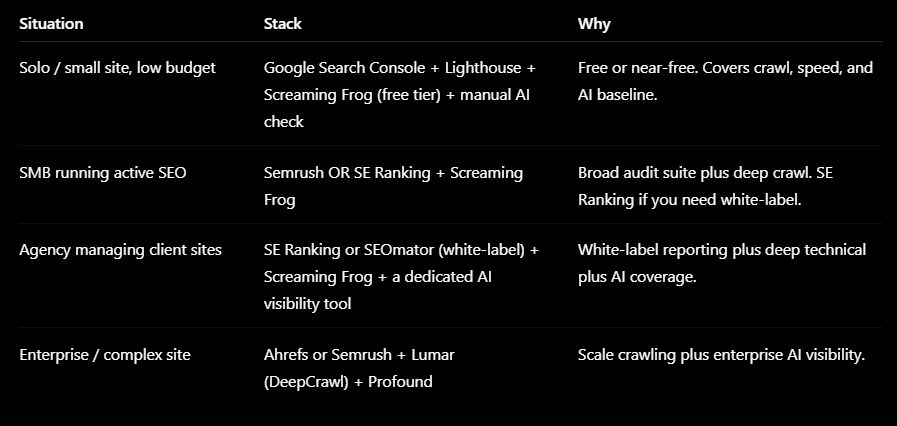
Three rules:
- Don't buy one platform expecting it to do everything. The "all-in-one" tools are good at breadth, weak at depth in specific categories.
- Always pair a broad suite (Semrush/Ahrefs/SE Ranking) with a deep crawler (Screaming Frog/Sitebulb).
- Add AI visibility auditing — it's now part of a complete audit, not an optional extra.
What Most Teams Get Wrong
Four common mistakes:
One: Buying for breadth, ignoring depth. Semrush is excellent broad coverage but its crawl depth doesn't match Screaming Frog or Sitebulb on complex sites. Know what each tool is genuinely best at.
Two: Auditing once and stopping. An audit is a snapshot. Sites change, content gets added, links get lost, AI citation patterns shift. Audit quarterly minimum.
Three: Ignoring AI visibility. Teams run a thorough technical audit in 2026 and never check whether they appear in AI answers. That's auditing half the picture.
Four: Flagging everything as equal priority. A good audit produces hundreds of issues. Most don't matter. Prioritise by traffic and revenue impact, not by issue count. Fixing a broken link on a page nobody visits is busywork.
Summary
The best SEO audit tool depends on which problem you're diagnosing, not on which brand ranks first. Use Screaming Frog or Sitebulb for deep technical crawls, Google Lighthouse for Core Web Vitals, Semrush or SE Ranking for content and on-page issues (SE Ranking for white-label), Ahrefs or Semrush for backlink audits, Google's Rich Results Test for schema, WAVE or axe for accessibility, and a dedicated tool (Profound, Otterly, Peec AI) for AI search visibility. Google Search Console is free and non-negotiable for any audit. Most teams need two or three focused tools, not one expensive all-in-one platform. And in 2026, a complete audit must include AI visibility — traditional crawlers can't see inside AI engines.
The shift to organise this by problem rather than by tool isn't just a formatting choice — it's how you should actually think about auditing. Diagnose the symptom, reach for the tool built for it. The team that does this spends less money and catches more problems than the team that buys whatever ranked #1 in a listicle and hopes it covers everything.
It won't. No single tool does.
Want a complete SEO audit that covers technical health, content, backlinks, AND AI search visibility — with a prioritised fix list ranked by revenue impact?
We run full-stack audits using the right tool for each problem category — deep technical crawl, content and on-page, backlink health, schema, and AI citation readiness across ChatGPT, Perplexity, and Google AI Overviews. The output is a prioritised action plan, not a 400-issue data dump.
FAQ
What's the best SEO audit tool in 2026? There's no single best tool — it depends on the problem. Screaming Frog and Sitebulb lead for deep technical crawls, Semrush and SE Ranking for content and broad audits, Ahrefs for backlink analysis, and dedicated tools like Profound and Otterly for AI search visibility. Google Search Console (free) is essential for every audit. Most teams need two or three focused tools rather than one platform.
Do I need a paid SEO audit tool, or are free ones enough? For small sites, free tools cover a lot: Google Search Console (indexing and Google's view of your site), Lighthouse (Core Web Vitals), and Screaming Frog's free tier (up to 500 URLs). You'd add a paid tool when you need to audit larger sites, get content recommendations, run backlink audits, or track AI visibility at scale.
How often should I run an SEO audit? A full audit quarterly at minimum, with lighter ongoing monitoring in between. Sites change constantly — content gets added, links get lost, Core Web Vitals shift, and AI citation patterns evolve. A once-a-year audit misses problems that develop and compound over months.
Can SEO audit tools check my AI search visibility? Traditional audit tools (Screaming Frog, Semrush, Ahrefs) cannot see inside AI engines like ChatGPT or Perplexity. You need a dedicated AI visibility tool (Profound, Otterly, Peec AI) or the bundled AI toolkit inside Semrush. In 2026, AI visibility is a core part of a complete audit — a technical-only audit is incomplete.
What's the difference between Screaming Frog and Semrush for audits? Screaming Frog is a dedicated deep-crawl tool — it excels at finding technical issues (broken links, redirect chains, crawl depth, structured data) across your entire site. Semrush is a broad suite where the site audit is one module among many; it's strong on issue prioritisation and integrates with keyword and backlink data, but its crawl depth doesn't match Screaming Frog on complex sites. Many teams use both.
How do I prioritise the issues an SEO audit finds? Prioritise by traffic and revenue impact, not by issue count. A good audit surfaces hundreds of issues, most of which don't materially affect rankings. Fix the problems on high-traffic, high-intent pages first. A broken link on a page nobody visits is busywork; a slow load time on your top converting page is urgent.