Every "best backlink monitoring tools" article on the internet looks identical. Ten tools. The same ten tools. The same Semrush screenshot. The same "43 trillion links in our database" line. The same comparison table where every column happens to look favourable.
I've read about forty of them this year. After a while you notice none of these articles tell you whether you actually need a backlink monitoring tool. They just assume you do, and then list the most expensive options first because that's where the affiliate commission is largest.
So this is a different article. I'm going to tell you what backlink monitoring actually does, why it matters more in 2026 than it did three years ago, which tools I'd genuinely pay for, and which ones I'd quietly walk past. Some of this will save you money. Some of it might save your search visibility — including the visibility you didn't know you had inside ChatGPT and Perplexity.
EXP — Running marketing at Emvigo, I've watched this play out enough times to stop being surprised. A publisher migrates their site, an editor leaves, a CMS gets swapped out — and a backlink that was quietly driving authority for months disappears. By the time someone notices the traffic dip on a key page, six weeks have passed and the only way to trace what happened is a tool that was watching the link the whole time.
What Is Backlink Monitoring? (And Why It's Not the Same as Backlink Checking)
Backlink monitoring is the practice of continuously tracking the inbound links pointing to your website — detecting when new links arrive, when existing links disappear, when a follow link silently turns nofollow, and when low-quality or spammy links start appearing in your profile.
It's different from backlink checking, which is a one-time snapshot. Checking is taking a photograph of your link profile today. Monitoring is installing CCTV that runs in the background and tells you when something changes.
The distinction matters because your most valuable links — the press feature, the industry roundup mention, the unprompted citation from a respected blog — are precisely the ones that disappear quietly. Sites get redesigned. Articles get archived. Editors leave. Pages return 404s. Nobody emails you to say "by the way, we removed your link." You only find out months later when traffic dips and you can't explain why.
A backlink checker tells you how many links you have today. A backlink monitoring tool tells you which links you lost yesterday. The first is a report. The second is an alarm system.
Why Backlink Monitoring Matters More in 2026
Three things have shifted in the last eighteen months. Together they make link monitoring more important now, not less — which is the opposite of what most people assume about SEO in the AI era.
One: Google's authority signal is still doing the work. Despite everyone declaring SEO dead, link-based authority remains one of the strongest ranking factors Google uses. Pages with strong, relevant inbound links rank. Pages without them don't. When you lose a link from a high-authority domain, you lose ranking signal — sometimes in days, sometimes over weeks. Either way, you'd want to know.
Two: AI search engines lean on link signals to decide who to trust. When ChatGPT, Perplexity, and Google's AI Overviews choose which sources to cite, they don't just look at content quality. They lean heavily on whether the source is trusted across the open web — and link signals are a major input into that trust assessment. If your competitor is being cited in ChatGPT answers and you aren't, one of the underlying reasons is often the link profile beneath them.
Three: Negative SEO is cheaper than ever. Anyone with fifty dollars and an afternoon can point a few thousand spammy links at your domain. You won't see this in Google Analytics. You won't see it in your CMS dashboard. You'll only see it in your backlink monitoring tool — if you have one set up.
Without monitoring, you're driving with no rearview mirror. Things are happening behind you. You just don't get to see them.
What I Actually Look For in a Tool
I don't care about the database-size boast. "43 trillion links" sounds impressive until you realise most of those links are dead, duplicated, or coming from sites nobody reads. Here's what I actually evaluate when comparing these tools — five things, not the thirty-column matrices you see elsewhere.
Alert speed. When a link goes from dofollow to nofollow, or disappears entirely, how fast do I find out? Same day is good. Within a week is workable. Once a month is too slow.
Sensible toxicity scoring. Half of these tools flag every link with a spam score above 20 as "toxic." That's lazy and dangerous — you can disavow yourself out of perfectly good rankings if you trust the red flag blindly. I want a tool that gives me enough context to make my own judgement.
Export and reporting. I work with clients. They want PDF reports. They want clean CSV exports. If a tool locks data inside its dashboard, it's useless for agency work.
Honest pricing for the tier I actually need. I don't run an enterprise. Most clients don't either. A $500/month plan aimed at agencies tracking thousands of domains is the wrong fit for a small SaaS company tracking one website and two competitors.
Indexation visibility. Knowing a link exists isn't enough. I need to know if Google has actually indexed the page linking to me. An unindexed backlink contributes nothing to your authority.
That's it. Five criteria. Now let's talk tools.
The Honest List
I've grouped these by what they actually solve for, not by alphabetical order or by who's paying the highest affiliate cut.
Tier 1: Worth Paying For (If You Can Justify It)
Ahrefs. Still the benchmark. Their crawler is the second most active on the open web after Google's own, and their backlink index updates roughly every 15 to 30 minutes for active sites. If link building, competitor reverse-engineering, and content gap analysis are central to your job, Ahrefs is the closest thing to a complete SEO operating system. Plans start around $129/month, which puts it out of reach for most small businesses. But for serious agencies and in-house growth teams, it earns its price.
Semrush. Bigger database (they claim 43 trillion links), wider toolkit covering SEO, PPC, content marketing, and competitor intelligence. Pricing starts around $139/month for the Pro plan. I'd pick Semrush over Ahrefs only if you're running paid media in parallel and want keyword + ad intelligence in the same place. For pure backlink work, Ahrefs feels cleaner.
You don't need both. Pick one. Anyone telling you they use both is either showing off or wasting their company's money.
Tier 2: The Affordable Workhorses
Linkody. This is what I recommend to most small businesses I work with. $14.90/month for two domains gets you 24/7 monitoring, lost-link alerts, anchor text breakdowns, toxic link detection, and white-label PDF reports. It isn't trying to be a full SEO suite. It just monitors backlinks reliably and pings you when something changes. That's exactly what 80% of people actually need.
SE Ranking. A good middle option. Affordable mid-tier pricing, decent backlink tracking, and unlike Linkody it also covers rank tracking and site audits in the same plan. If you want one tool that does several jobs adequately rather than one job perfectly, SE Ranking is the pick.
Tier 3: Free + Free-ish
Google Search Console. Everyone should have this turned on, full stop. It's free, it's direct from Google, and it shows you the links Google has actually attributed to your site — which is the only opinion that ultimately matters for Google rankings. The limitations: it's incomplete (Google doesn't show all links), and it has no alerting system. You have to remember to check it. But as a free baseline, nothing else comes close.
Backlink Pilot. Free plan covers 500 backlinks checked once a month. Limited but genuinely useful for solopreneurs and side projects. The big constraint is that checks happen only once a month on the free tier, so if you lose a link on day 3, you find out on day 30. For zero dollars, hard to complain.
Skip These
There's a category of tools that exist mostly to be reviewed on affiliate sites. They look almost identical to the ones above — similar pricing, similar dashboards, similar features in the screenshots. But their crawls are slow, their data is sparse, their changelogs haven't been updated since 2022, and their support tickets disappear into a void.
I won't name names because the legal risk isn't worth it. But you'll know one when you see it: the website hasn't shifted visual style in four years, the blog hasn't been updated in eighteen months, the pricing page works but everything else is broken, and the only "reviews" of the tool are on affiliate sites earning 30% commission per sale.
Two simple filters before you pay anyone:
- Is the tool actively shipping product updates? (Check their changelog or Twitter.)
- Are there real reviews on G2 or Capterra from the last six months — not just affiliate listicles?
If both answers are no, walk away.
Which Tool Should You Actually Pick?
No fluff. Decision table.
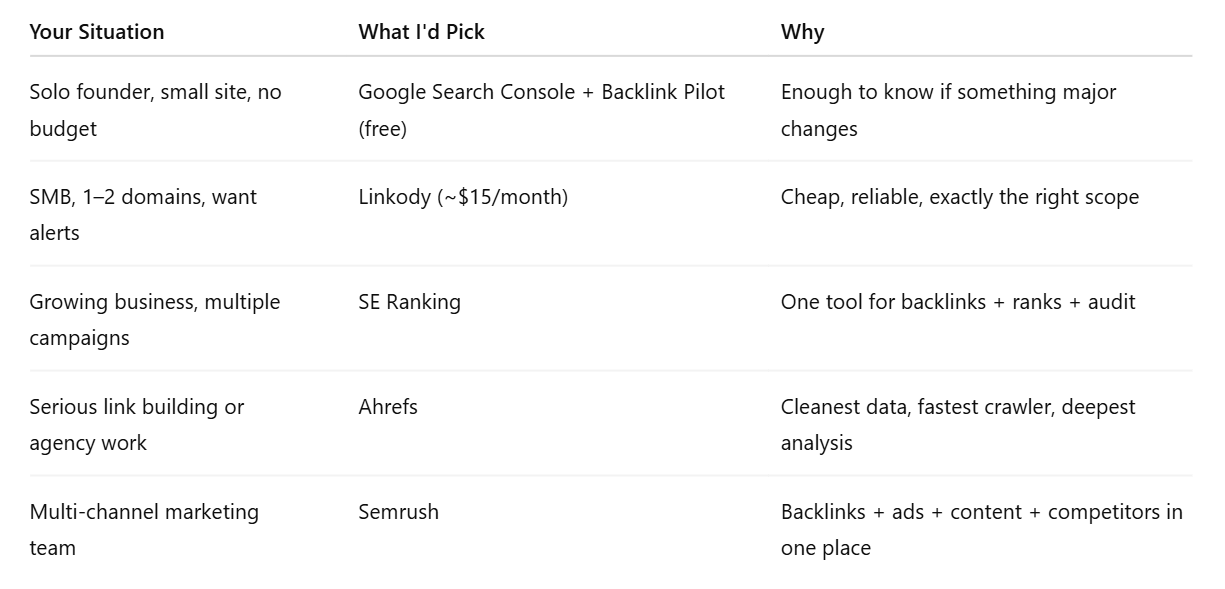
The most expensive marketing-tools mistake I see is agencies signing up for Ahrefs and using 10% of it, when Linkody at a tenth the price would have done the job they actually had. Pay for the tier that matches your use, not the tier that matches your ambition.
The 2026 Angle Nobody Else Is Writing About
Here's what every other backlink monitoring article on the SERP misses: in 2026, backlinks don't just influence Google rankings. They influence whether you get cited inside ChatGPT, Perplexity, and Google's AI Overviews at all.
[EXP — In my work at Emvigo, the pages that get picked up by LLM visibility — surfaced in ChatGPT answers, cited by Perplexity, appearing in Google AI Overviews — almost always have a stronger, more topically relevant backlink profile underneath them than the pages that don't. The correlation isn't a coincidence. AI search systems borrow heavily from open-web authority signals when deciding which sources to trust enough to cite.]
This changes the calculus on link monitoring entirely. Losing a link from a high-authority site isn't just a Google ranking risk anymore. It's a risk to your AI citation eligibility — your presence in the discovery channel that's quietly growing fastest.
[DAB] In 2026, backlinks feed two ranking systems at once: Google's traditional ranking algorithm, and the trust signals AI search engines use to decide which sources to cite in their answers. Monitoring backlinks is now monitoring AI visibility, not just SEO. [/DAB]
If you aren't measuring AI citations yet, start now. Pick your ten most commercially important queries. Run them through ChatGPT, Perplexity, and Google AI Overviews once a month. Screenshot the results. Note whether your brand appears, which competitors appear, and which sources are being cited. Pair that monthly check with your backlink monitoring tool, and over time you'll start to see patterns — which links lift AI visibility, which losses cost you citations, which kinds of content keep getting picked up.
This is the layer where competent SEO becomes uncompetent SEO becomes invisible-to-AI SEO. No backlink monitoring tool on the market currently correlates link changes with AI citation changes — the integration hasn't been built. So for the next year or two, you have to connect those dots manually. The businesses that do it now will compound a real advantage by the time the tools catch up.
Summary: Key Takeaways
[DAB] The short version. Most backlink monitoring articles list the same ten tools because they earn the same ten affiliate commissions. The real answer depends on your stage. Solo founders need Google Search Console plus a free tier like Backlink Pilot. Small and growing businesses are best served by Linkody at around $15/month. Agencies and serious link builders should pay for Ahrefs or Semrush. Whatever tool you choose, the reason it matters more in 2026 is the same: backlinks now feed both Google rankings and AI citation eligibility, so losing a high-quality link can cost you visibility in two channels at once. [/DAB]
Most businesses don't need the most expensive tool. They need a tool, plus the discipline to actually check it weekly.
If you've never seen a complete picture of your own backlink profile — what's pointing to you, what you've lost in the last quarter, and which links are quietly carrying most of your authority — that's the audit to run first. Everything else is downstream of knowing what you actually have.
Want a backlink audit that tells you what's actually happening to your link profile — and what it means for your AI search visibility?
We run combined backlink + AI citation audits for businesses serious about being found in 2026's search landscape — Google, ChatGPT, Perplexity, and every other place discovery is now happening.
FAQ
What's the difference between a backlink checker and a backlink monitoring tool? A backlink checker gives you a snapshot of your link profile at a single point in time. A monitoring tool continuously tracks changes — new links gained, existing links lost, anchor text shifts, follow-to-nofollow conversions — and alerts you when they happen.
Do I really need a paid tool, or is Google Search Console enough? For very small sites without active link-building, GSC alone is often enough. For anyone running outreach campaigns, doing competitor analysis, or managing link health for clients, you need a dedicated tool — GSC doesn't show all your links, doesn't alert you to changes, and doesn't give you competitor data.
How often should I check my backlink profile? Set up automatic weekly alerts via your tool of choice, then do a manual deep dive once a quarter. Daily checking is overkill for most businesses and leads to alert fatigue.
Are toxic backlinks still a real problem in 2026? Yes, but less acute than five years ago. Google's algorithm now ignores most low-quality links automatically. The disavow tool still exists, but you should only use it when there's clear evidence of negative SEO — not just because a third-party tool flagged a random link as "spammy."
Can backlinks affect my visibility in AI search like ChatGPT and Perplexity? Indirectly, yes — and increasingly so. AI search engines use authority signals (including backlinks) to decide which sources are trustworthy enough to cite. A stronger, more relevant backlink profile generally correlates with more AI citations, though the relationship isn't perfectly linear.
What's the cheapest reliable backlink monitoring tool? Linkody at around $14.90/month is the best value option for most SMBs. Below that, Google Search Console plus Backlink Pilot's free tier covers the basics — but with manual checking and slower alerts.